

Cutting Through the Noise: The No-Nonsense DIY Guide to the Top 5 Flooring Types
Thinking about ripping out those old, tired floors and tackling your own installation? Doing it yourself can save you a chunk of money on labor, give you a massive sense of pride, and completely transform your home.
But if you walk into a big-box home improvement store, you’re going to be hit with a wall of marketing buzzwords. Everything claims to be “scratch-resistant,” “lifeproof,” and “indestructible.”
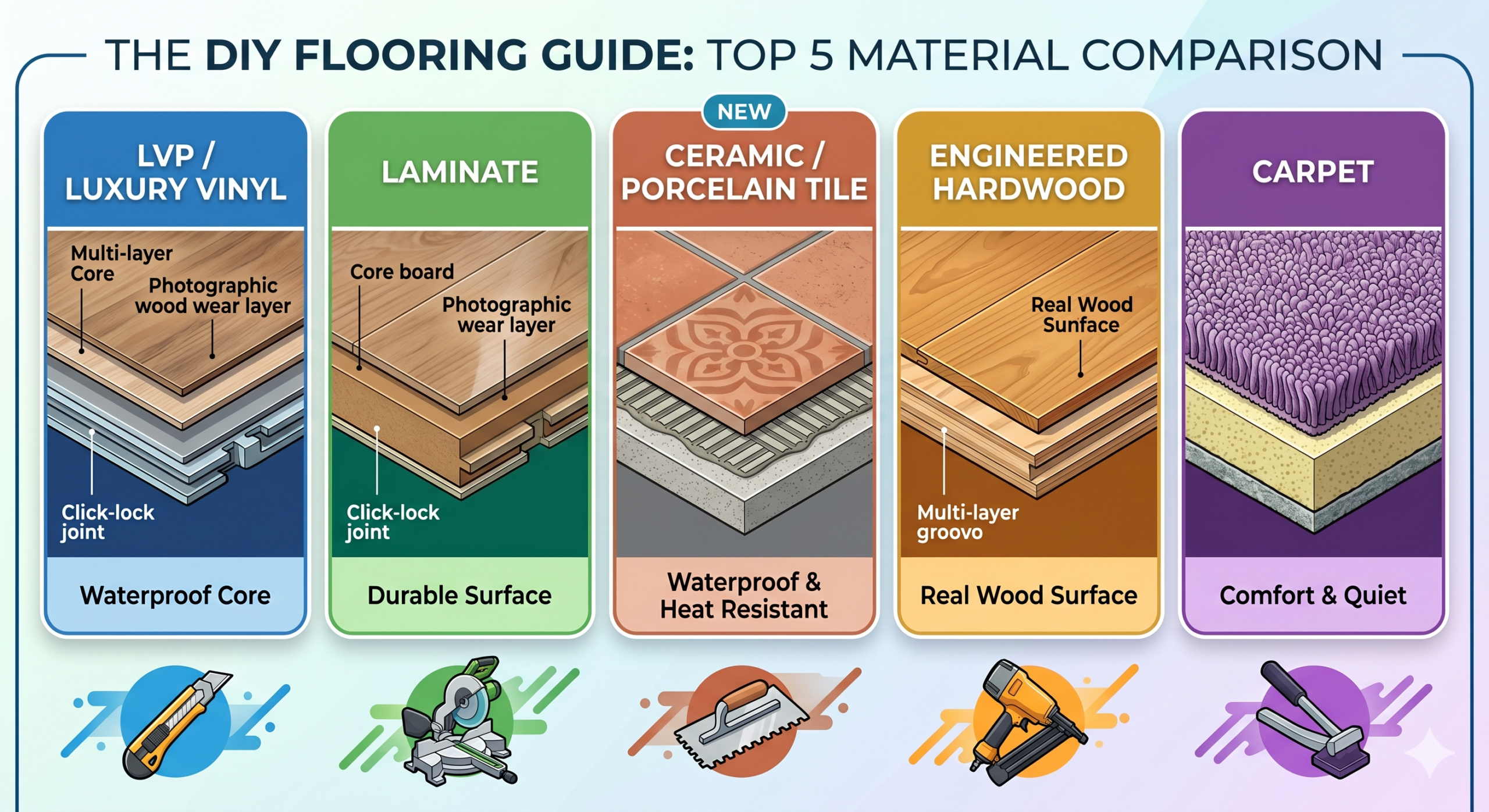
- Luxury Vinyl Plank (LVP)
LVP is the undisputed heavy hitter of the modern remodeling world, especially for folks who want the look of warm wood tones without the high-maintenance upkeep.
- The Pros: It is 100% waterproof, making it the perfect choice for kitchens, mudrooms, and basements where humidity or accidental plumbing failures happen. It shrugs off muddy dog paws and dropped juice boxes, and modern textures do an incredible job of hiding minor scuffs.
- The Cons: It requires a nearly flawless, dead-level subfloor (less than 3/16” difference). Because LVP is flexible, if your subfloor has low spots or ridges, the locking joints will eventually flex, break, and separate under your footsteps. Also, cheap, thin vinyl feels hard and cold underfoot. While the planks themselves are waterproof, water can still seep between the joints and ruin your subfloor. Also, if you do have a water disaster and you have to take the planks apart, you can not reinstall them and will have to replace them.
- DIY Difficulty: Easy. Most varieties use a user-friendly click-lock floating system. You don’t need fancy power saws; you can score and snap the planks with a simple utility knife.
- Rohr’s Recommendation (Nathan’s Take): Level subflooring is the most crucial part of installing LVP. Nathan recommends a 20 mil plank. It is also Rohr’s recommendation that you avoid using lvp for basements, due to the potential of flooding underneath the flooring. Call us for a consultation and inspection to ensure that you are ready to install like the pros.
- Laminate Flooring
Laminate has made a massive comeback. Forget the cheap, hollow-sounding plastic floors from twenty years ago; modern high-end laminate looks and feels strikingly close to genuine hardwood.
- The Pros: Laminate is actually harder and more scratch-resistant than real hardwood or vinyl, thanks to its dense top wear-layer. It resists fading in sunny living rooms and doesn’t dent easily under heavy furniture. It’s a stellar budget-friendly option for busy, high-traffic hallways.
- The Cons: Moisture is its mortal enemy. While some newer options are labeled “waterproof,” the core of laminate is still compressed wood fiber. If water leaks through the seams and sits, it will swell up like a sponge, ruin the edges, and the floor cannot be repaired—it has to be replaced.
- DIY Difficulty: Moderate. It uses a click-lock floating system similar to vinyl, but because it’s a rigid fiberboard, you will need a jigsaw or miter saw to make your cuts, which adds airborne dust to your project space.
- Rohr’s Recommendation (Rich & Nathan’s Take):This is one of our favorites for a lasting plank.
- Ceramic & Porcelain Tile
If you need a floor that is truly bulletproof against water, heat, and heavy scrubbing, traditional tile is the reigning champion.
- The Pros: It is completely waterproof, making it the only appropriate choice for high-moisture areas like shower enclosures. It is incredibly durable; a quality, properly installed porcelain floor can last decades. It also offers the widest range of design options, from sleek modern concrete looks to intricate wood-grain patterns.
- The Cons: It is unforgivingly hard and cold underfoot (though excellent for in-floor radiant heating). The grout lines require sealing and regular maintenance, as they are porous and will stain. Furthermore, the installation process is messy, dusty, and time-consuming.
- DIY Difficulty: Hard. Tiling requires specialized tools (wet saws, snap cutters, notched trowels). Subfloor preparation is critical; any flex in the subfloor will cause the grout or the tile itself to crack. Getting perfectly spaced, flat tiles without “lippage” (edges sticking up) is a skill that takes practice.
- Rohr’s Recommendation (Rich & Nathan’s Take): While Rohr’s doesn’t do tile installation, we do help with cleaning and we recommend scheduling a grout cleaning and sealing every 1 – 2 years to keep your floors looking nice.
- Engineered Hardwood
If you refuse to look at a photographic print and demand real, authentic wood under your feet, engineered hardwood is the modern homeowner’s answer to old-school solid timber.
- The Pros: It features a top veneer of genuine hardwood (like Oak, Hickory, or Walnut), meaning every single plank has completely unique, natural grain variation. Because it’s built over a cross-layered plywood base, it doesn’t shrink, warp, or cup when humidity shifts nearly as badly as solid wood does. It instantly boosts a home’s resale value.
- The Cons: It is still real wood, which means it will scratch if you drag a heavy chair across it or let your dog’s nails get too long. It is also significantly more expensive per square foot than vinyl or laminate.
- DIY Difficulty: Hard. While some click-lock floating engineered options exist, the highest-quality thick-veneer products usually require gluing down to a concrete slab or using a professional flooring nailer over a wood subfloor. Precision counts here.
- Rohr’s Recommendation (Rich & Nathan’s Take): Hardwood is beautiful but it will scratch, is difficult to install and requires a real investment.
- Carpet (Plush & Patterns)
Don’t count carpet out. Cozy, textured carpets are seeing a huge resurgence for upper-level rooms, children’s play areas, and bedrooms where comfort and noise reduction matter most.
- The Pros: It provides unparalleled thermal insulation and sound absorption. It stops echoes in rooms with high ceilings and gives a soft, safe surface for kids to play on. Premium fibers like Nylon have incredible “molecular memory,” allowing them to bounce back after being walked on or crushed by heavy bedroom dressers.
- The Cons: It acts like a giant household air filter, trapping dust, pet dander, and allergens over time. It requires strict, consistent maintenance (including professional high-heat extraction every 12 to 18 months) to prevent permanent matting and to protect your manufacturer warranty.
- DIY Difficulty: Very Hard. Unless you are using temporary, square carpet tiles for a basic home gym or small office, wall-to-wall carpet requires specialized tools like power stretchers, knee kickers, and hot-melt seam irons to prevent loose ripples down the road. This is usually the boundary where DIY-ers call in backup.
- Rohr’s Recommendation (Rich & Nathan’s Take): Nylon is more stain resistant and polyesters are softer and cheaper.
The Final Step: Check Your Work Before You Buy
Whether you are choosing a click-lock vinyl for a basement, an authentic wood for the master suite, or a porcelain tile for the kitchen, the biggest mistake a DIYer can make is buying blindly online or off a tiny screen sketch.
Before you pull the trigger, you need to feel the texture, check the thickness of the locking mechanisms, and see how the colors change under the actual lighting of your home.
Drop by our showroom at 722 E. 7th St. in Hays! We’ll let you feel the samples, look at the backings, and give you honest, straight-shooting advice on subfloor prep and tools before you tackle your weekend project. Questions? Call the office at (785) 625-5977!